

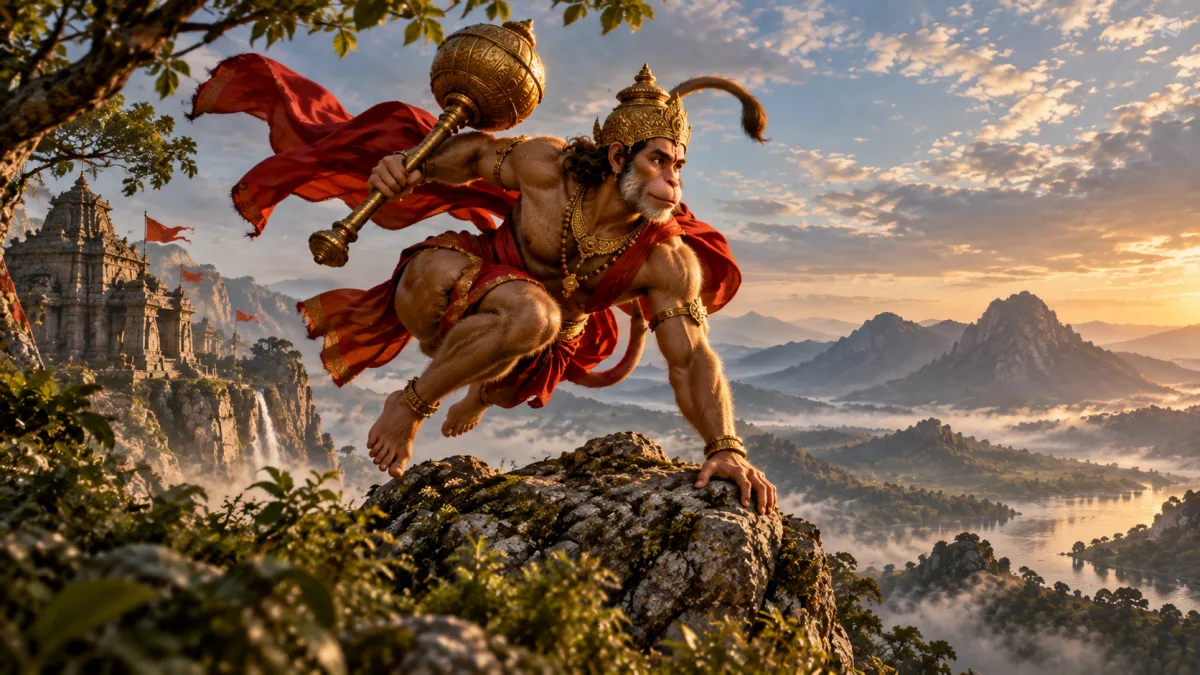
The force of movement, pursuit, conflict, and transformation.
Mangala is life in motion. He is the thrust that pushes forward, the instinct to pursue, compete, penetrate obstacles, defend territory, build, fight, discover, and begin again. Blood, muscle, heat, engines, weapons, engineering, athletics, surgery, and physical courage all belong to his field because they express the same principle: energy becoming action.
Yet Mangala is not simply the graha of aggression. The same force that wounds can operate, rebuild, rescue, engineer, and heal. Mangala governs both birth and rebirth — the emergence of embodied vitality through Mesha and the profound transformations of Vrischika. His deeper lesson concerns what we do with power once it begins to move through us.
The primal force of movement
Among the graha, Mangala is remarkably direct. Where Budha analyzes and communicates, Shukra attracts and negotiates, Guru expands meaning, and Shani establishes limits, Mangala acts. His intelligence is kinetic. He learns through doing. Kuja is therefore associated with movement, pursuit, competition, challenge, invasion, penetration, cutting, digging, drilling, construction, machinery, heat, blood, flesh, weapons, sexuality, athletics, military action, and engineering. These apparently different significations share one principle: force crossing a boundary. A runner pushes the body beyond its previous limit. An engineer penetrates matter and reorganizes it. A surgeon cuts into the body to repair it. A warrior enters contested territory. A lover pursues. An explorer enters what was previously inaccessible. Mangala asks: Where is the obstacle, and how do we move through it?
Kuja: born from the Earth
One of Mangala's important names is Kuja — “born from the Earth.” Other traditional names similarly connect him with Bhumi, the Earth. This symbolism is important. Mangala is not abstract energy. His force seeks embodiment. He governs blood and muscular vitality, physical exertion and the instinctive nervous system. His world is tangible: land, metals, machines, tools, construction, wounds, heat, sexuality, physical competition, and the struggle required to establish oneself within material existence. Traditional descriptions emphasize his reddish appearance, fiery constitution, youthfulness, restlessness, courage, anger, and vigorous sexuality. Thus Mangala represents something ancient within human consciousness: the organism's capacity to move toward what it wants and against what threatens it. Without this force, intention remains intention.
Mesha and Vrischika: birth and rebirth
Mangala rules two rashis whose meanings reveal two different dimensions of his power. Mesha represents emergence into visible embodied existence. It is the beginning, the first movement, the blood-and-body experience of birth. Mangala here operates as the pioneer: direct, competitive, self-propelled, eager to arrive first. Vrischika moves the same principle beneath the surface. Here Mangala penetrates hidden territory. The movement becomes excavation, surgery, secrecy, crisis, investigation, tantra, psychological transformation, and regeneration. Thus Mangala governs not only starting but restarting. A major surgery can produce a new relationship with the body. A crisis can destroy an old identity. A hidden truth can erupt and permanently alter one's life. Deep therapeutic or tantric processes can dismantle one container of vitality so that another may emerge. Bhava-1 and bhava-8 therefore express complementary dimensions of Kuja: birth and transformation, embodiment and regeneration.
The agent of pursuit
Mangala is fundamentally a pursuer. In relationships, Shukra may describe attraction, agreement, and the magnetism that draws two parties together. Mangala describes the force that goes after the object of desire. The same principle appears outside romance. Mangala pursues victory in sport, territory in warfare, discovery in research, profit in competition, solutions in engineering, criminals in police work, hidden causes in investigation, and damaged tissue in surgery. The rashi occupied by Mangala describes the environment and style through which this pursuit tends to operate. Mangala in Mesha may pursue directly and competitively. In Vrischika, the pursuit penetrates concealed territory. In Makara, where Mangala is uchcha, force becomes organized toward structure, rank, authority, and concrete achievement. In Karkata, where Mangala is neecha, the same forward-driving force must operate through the sensitive field of security, nourishment, home, belonging, and emotional protection. The problem is not an absence of energy; rather, the natural style of the graha and the environment through which it must operate are poorly coordinated.
Mangala through the bhava
Bhava placement tells us where the pressure to act appears. Mangala in bhava-1 energizes the body, identity, initiative, competition, and direct self-assertion. In bhava-3, the force enters communication, commerce, teamwork, skills, and enterprise. In bhava-6, Mangala can become particularly effective in environments requiring confrontation: defeating adversaries, treating disease, managing disputes, litigation, military strategy, or other forms of conflict. In bhava-8, Mangala operates naturally within crisis, excavation, emergency, hidden processes, surgery, and transformation. In karma-sthana bhava-10, Mangala receives dikbala. His forward-driving force can become strongly directed toward rank, leadership, executive action, governance, professional competition, and visible accomplishment. But no placement should be read as an isolated formula. A strong Mangala is not automatically a benevolent Mangala. Strength tells us how effectively a graha can act; it does not by itself tell us whether its action will produce desirable results. Functional lordship, dignity, drishti, conjunctions, yogas, varga confirmation, and the overall architecture of the nativity remain essential.
Mangala's special drishti
Mangala does not merely energize the bhava he occupies. His special 4th and 8th drishti, together with the standard 7th drishti, project his active, penetrating force into other parts of the nativity. Where Mangala sees, something tends to become activated. There may be competition, construction, urgency, defense, intervention, argument, technical problem-solving, sexuality, or pressure for decisive movement. This can be particularly significant when Mangala influences bhava-10. His abundant movement-energy can supply professional life with persistence, ambition, competitiveness, and the desire to produce visible results. Yet again, activation is not synonymous with ease. Mangala may energize a field precisely by creating something that must be fought for.
Mangala with other graha
Yuti and mutual influence modify the way Mangala's force is expressed.
- With Surya, Mangala can intensify confidence, competition, leadership, creativity, and the desire to win.
- With Chandra, emotions acquire propulsion. Feeling becomes action; security may be sought through control, conquest, protection, or vigorous caretaking.
- With Budha, communication becomes incisive, rapid, commanding, argumentative, or technically precise.
- With Guru, Mangala's drive joins expansion, conviction, teaching, philosophy, and sometimes aggressive promotion of beliefs.
- With Shukra, pursuit meets attraction. Sexuality, negotiation, trade, alliance, and competitive partnership become strongly energized.
- With Shani, the contrast is profound. Mangala wants immediate movement; Shani imposes structure, delay, discipline, and containment. Properly coordinated, this tension can produce formidable endurance and controlled force. Poorly integrated, it can feel like continuously pressing the accelerator against the brake.
- With Rahu, desire and ambition can become amplified, adventurous, compulsive, or fascinated with risk and conquest.
- With Ketu, the direction of the force may become fragmented or detached. Action can be vigorous yet strangely disconnected from ordinary goals.
None of these combinations has a single inevitable outcome. Their manifestation depends upon dignity, lordship, bhava, drishti, avastha, varga support, and dasha activation.
Strength is not beneficence
Mangala is traditionally classified as a natural papa-graha, but this does not mean that he must produce undesirable results in every nativity. Functional lordship matters. The same Mangala may govern a trikona in one lagna and difficult bhava in another. A powerful Mangala that owns auspicious houses can produce exceptional capacity for achievement; a powerful Mangala connected strongly with difficult houses may become equally effective at producing conflict, rupture, injury, or pressure. This distinction is fundamental: A graha can be powerful without being benefic. Likewise, uccha does not mean that every result becomes pleasant. Exaltation can make Mangala exceptionally capable of doing what Mangala does. Whether that force builds a bridge, commands an organization, wins a competition, performs surgery, destroys an obstacle, or intensifies conflict depends upon the complete nativity.
Mangala dasha: when energy demands expression
Mangala mahadasha or antardasha can release enormous quantities of active energy. When natal Mangala is well placed and integrated with the rest of the horoscope, these periods may become extraordinarily productive. They can support initiative, entrepreneurship, physical development, engineering, leadership, competitive achievement, construction, technical work, decisive career movement, or major transformation. When Mangala is poorly coordinated, the same energy may manifest as impatience, conflict, anger, accidents, rash decisions, or destructive competition. The important principle is that dasha does not invent a Mangala that was absent from the natal chart. The natal promise comes first. Dasha activates it. A strong Makara Mangala, a well-supported Mangala in Mesha or Vrischika, Mangala with dikbala in bhava-10, or Mangala powerfully influencing professional houses may therefore produce very different results from a damaged or functionally difficult Mangala whose natal indications already connect force with conflict.
Anger as obstructed Mangala
One of the most important themes in understanding Mangala is anger. Anger is not separate from vitality. It is vitality encountering resistance. At its most primitive level, Mangala protects life. When the organism experiences threat, restriction, invasion, suffocation, or loss of essential resources, force rises. For a short time this reaction can be extremely useful. The problem begins when the mobilized energy cannot complete its movement. Suppressed Mangala does not cease to exist. The force may become resentment, chronic agitation, compulsive competition, hostility, bodily tension, or repeated confrontations with people who seem to embody the aggression that one cannot consciously acknowledge. From this perspective, the task is not simply to “eliminate anger.” It is to understand what force is trying to move and why its movement has become obstructed. Physical movement can therefore be especially compatible with Mangala: running, vigorous dance, martial arts, athletics, demanding manual work, and other activities capable of giving intense kinetic energy a constructive channel.
The body as a field of Mangala
Because Mangala signifies blood, heat, muscles, cutting, inflammation, and injury, his condition can also be reflected through the body. The rashi and nakshatra occupied by Mangala may identify bodily zones where excessive heat, movement, irritation, tension, or injury is more easily expressed, especially when additional health-related factors reinforce the indication. This should not be reduced to a simplistic equation such as “Mars in a sign causes disease in a particular organ.” The Jyotish judgment must consider the relevant bhava, rogesha, lagna and lagnesha, Chandra, drishti, dignity, dasha, and supporting or mitigating indications elsewhere in the nativity. Mangala signifies the mechanism of irritation and force; whether that mechanism actually becomes illness requires broader confirmation.
Conflict as part of creation
Mangala's symbolism contains an uncomfortable truth: creation itself often requires destruction. Birth breaks an existing condition. Construction cuts, drills, excavates, and rearranges matter. Surgery damages tissue in order to heal the organism. Innovation destroys established procedures. Competition eliminates alternatives. Psychological transformation dismantles identities that once provided security. Mangala therefore cannot be understood merely as “violence.” He represents the rupture required for movement. This is why the same graha signifies warfare and engineering, wounds and surgery, aggression and rescue, destruction and rebirth. The force itself is morally neutral. Its expression depends upon consciousness, circumstance, and the architecture of the horoscope.
The discipline of conscious action
Mangala's highest potential is not passivity. It is conscious force. The developed expression of Kuja knows when to act, where to direct energy, what obstacle must be penetrated, and when a battle is no longer worth fighting. Without awareness, Mangala reacts. With awareness, Mangala acts. The distinction is enormous. A reactive Mangala can spend tremendous vitality defending threatened identities, fighting unnecessary opponents, repeating old conflicts, or attempting to dominate whatever resists him. A conscious Mangala can direct precisely the same reservoir of energy toward building, healing, protecting, competing, discovering, leading, and transforming. 🪐 The question posed by Mangala is therefore not whether we possess aggression. Embodied life itself contains the force of pursuit, defense, and survival. The deeper question is: What will we do with the power that moves through us?
Mangala provides the fuel. The nativity describes its channels. Dasha determines when those channels become strongly activated. Consciousness determines whether the fire merely burns — or becomes the force by which something new is born.


